Monday, May 17, 2021

The Adventure of a Lifetime in a Fantastical World - The Mark of the Dragonfly by Jaleigh Johnson

     The Mark of the Dragonfly (World of Solace Series): Johnson, Jaleigh:  9780385376471: Amazon.com: Books

    Many stories tell of a strange earth-like steampunk world but none are as unique as The Mark of The Dragonfly. In the beginning of the book, the reader is greeted with a map of an unusual and unfamiliar continent called Solace, but as the reader goes on, the world of Solace is built with it, and the different areas on the map are explained. The world is made up of two rival kingdoms, the Merrow Kingdom and the Dragonfly Territories, but in the north of the continent lies a great field where meteor showers bring strange artifacts from other worlds with them. This strange occurrence has dictated the lives of many people, including the main character Piper, who works as a mechanic for artifacts found in the meteor field. Piper's life alone, after losing her father, was bland and uneventful until the biggest meteor shower in years brings something that will change her life forever and allow her to leave the miserable scrap towns. All in all, the location-based narrative structure immerses the reader in the fantastical world the characters travel through on their journey to escape.

    One of the most interesting characters of the story is the character Anna. Although Anna becomes a more established character as time goes on, her origins are mysterious. When Piper finds Anna in the wreck of a caravan destroyed by the meteor showers she brings her back to her house to recover. There she finds Anna is a member of the royalty in the Dragonfly Territories, bearing the Dragonfly tattoo, but has lost her memory in the accident. Anna's mysterious past, including the mystery behind why a member of royalty was in the middle of a meteor storm in the first place, causes problems along their journey. This mysterious element in the story makes the reader want to keep reading to investigate and uncover the truth behind Anna.

    Although Piper's journey to return Anna to the Dragonfly Territories comes with reward and later proves to be necessary to protect Anna, it does not come without conflict. One problem Piper has with her journey is that since Piper chose to break the law by leaving the shelter to save her friend Micah, Piper is wanted by the authorities. This forces Piper to act discretely in her journey and make the decision to leave her home town to protect herself and safely return Anna. Piper's fugitive status makes returning Anna to the distant Dragonfly Territories even more difficult and outlandish, yet interesting to follow. In addition to this problem, Piper has an internal conflict with the fact that her father died while working in a factory belonging to the Dragonfly king, and blames it on him. Piper's line "King Aron had built the factory in Noveen, the monster that had swallowed Piper's father up and made him breathe poisonous smoke" (Johnson 47), shows that she is resentful and seeks revenge for her father. Therefore, she is not inclined to help the king by returning a member of his royalty. These conflicts and her desire for revenge make Piper a complex and interesting character to follow.

    Only thirteen years old, Piper is on her own without any immediate family and works as a scavenger and repairer. For Piper, her only remaining family are Micah, Jory, and their parents who have always helped and been kind to her. When Micah, Piper's best friend, is injured during the meteor storm and slips into a coma, Piper is worried she will lose a part of the only family she has left. The adventure ahead of her not only helps her fulfill her dream of exploring the world, but helps her to make new friends and find new family. Overall, this is a very well written novel and the first of a series that explores the mystical world of Solace, following Piper and her friends on a journey to uncover mysteries and find a better life.

The Mark of the Dragonfly by Jaleigh Johnson, 386 pp, RL 4

Kelby

Thursday, March 25, 2021

The Three Body Problem


    In the vast expanse of space at a system known as Trisolaris, three stars dance around each other in an irregular and unpredictable dance, with a planet drifting through the gravitational influence of the three bodies, subject to both extreme heat and cold. Against all odds, civilization sprouts on this planet, weathering the constant disasters the three suns bring. Before the three suns destroy the planet once and for all, this civilization hopes to voyage to a safer planet. So, this civilization embarks on a four hundred year journey on its way to conquer an eternally mild planet a mere 4 light years away, flourishing with life of its own, known to us humans as 'Earth'.

    This is the world of The Three Body Problem, a novel written by Liu Cixin. The Three Body Problem is a great novel, unlike any which I have read before, thanks to usage of multiple perspectives to add to the main point of view, the usage of history and science in its storytelling process, and the somewhat nuanced nature of the main conflict in the story.

    The Three Body Problem starts at the height of the Cultural Revolution, centering on a young scientist named Ye Wenjie whose father had just been beaten to death, and then sent to work in the wilderness, eventually settling in a secretive radio telescope base known as Red Coast. One of the greatest parts of the novel, especially in this section, is its references to historical events and depiction of the Cultural Revolution. The atmosphere of the Cultural Revolution, and its focus on politics in every part of life, significantly affects how Ye is able to conduct research and live life at Red Coast. Often, she and her colleagues are very sensitive to how their work will create political symbolism, or associate with counter-revolutionaries, or otherwise do politically dangerous actions. Even in transmissions to potential extraterrestrial life, the Cultural Revolution's influence shows in the first few drafts of the transmission. 

    Another great element of The Three Body Problem is how the author switches between different points of view in order to provide the reader a more complete and interesting picture of events. The first section of the story is written in the point of view of Ye Wenjie, the young scientist at Red Coast. However, the story is mostly told through the perspective of Wang Miao, a present day engineer, as he tries to make sense of what is going on around him in regards to Trisolaris and the people associated with Trisolaris. Later, the perspective switches back to Ye, showing what she did after being sent to Red Coast. The story also features the perspective of a mathematician, and how he interacted with a pro-Trisolaris organization. Near the end of the story, when the government receives a hard drive full of transmissions from Trisolaris acquired from the pro-Trisolaris organization, the perspective even switches to the point of view of Trisolaris, at first focusing on the operator of a radio receiver, and then expanding into an omnicscient view of all of Trisolaris.

    After Ye Wenjie saw her father beat to death and was later persecuted due to the Cultural Revolution, she began to harbor misgivings about the people around her, and of humanity as a whole. Eventually, after witnessing firsthand the bad sides of humanity, and reading philosophical material during her time at Red Coast Base, this developed into the conclusion that humanity is generally an evil species. When she discovered the existence of Trisolaris, this led her to seek the help of Trisolaran civilization to reform human society. That premise, repeated and emphasized over and over again throughout the story, helps us ask questions about what we think about Ye's views. For example, what are the flaws in human nature and human society? Do those flaws characterize the nature of humanity as evil? And if so, does the evil of human society warrant an intervention by a foreign power (such as Trisolaris)? These questions often consumed my thoughts as I was reading and rereading the story, and gave me more insight onto why the pro-Trisolaris characters acted the way they did. 
    When the perspective switched to that of Trisolaris, a lone radio receiver operator stood in the position of Ye Wenjie, an isolated individual dissatisfied with their current circumstances. While we do not get any insight onto this receiver's past, we know through his conversations with others that he would much prefer human civilization over Trisolaran civilization, viewing human civilization as culturally rich, free, and prosperous, in comparison to the totalitarian nature of Trisolaran civilization, in which the only punishment for crimes is death. For this reason, he tries to save Earth from Trisolaran invasion, risking the very survival of Trisolaris in the process. These revelations also were very interesting to learn about, and they changed my outlook on the conflicts occuring at Earth in the story. Those who wanted to improve human civilization through foreign intervention have in fact made a grave mistake, inviting a powerful totalitarian regime to conquer Earth. Such a regime would certainly not spare humanity, and even if humanity was spared and merely subjugated, Trisolaran civilization would most definitely be a negative influence on humanity. 

    There are many elements of the story which I decided to omit, and countless small details which would take too much time to cover. However, what sets The Three Body Problem apart from other novels I read are its incorporation of history, several perspectives, and interesting ideas and themes on the nature of humanity. Overall, The Three Body Problem is a complex, interesting novel which I encourage everyone to read.  

Sunday, March 7, 2021

Honest and Hilarious Happenings in Hyperbole and a Half


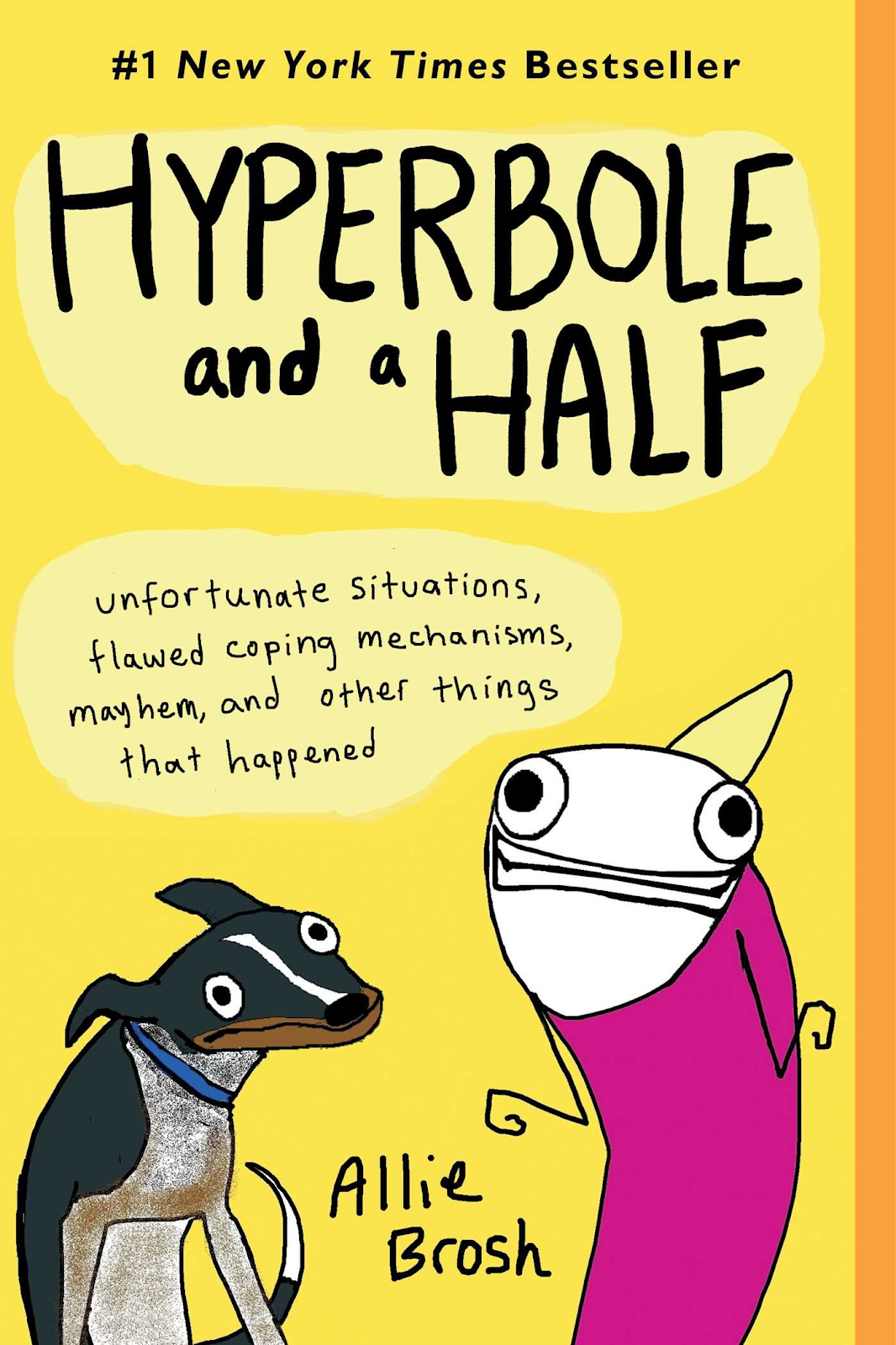
The hard-to-believe but true stories of Allie Brosh create the humorous and slightly concerning autobiographical graphic novel Hyperbole and a Half. She invites us into the mind of her dog-obsessed childhood self, tells of her “simple-dog” and “helper dog,” and also shares a candid insight into her struggles with depression. 

Her childhood stories are the parts that made me laugh out loud the most because while she was already a quirky child, the humor that she uses to express those peculiarities makes them even funnier. Normally, adults don’t always remember what they were thinking when they were younger, but it seems that Brosh still has quite a healthy relationship with her child-self. In one of the first stories in the graphic novel, she tells about the time when she found a letter to her future 25-year-old self written by her ten-year-old self. The letter asks multiple questions on the topics of dogs: “Do you still like dogs? What is your favorite dog? Do you have a job training dogs? Is Murphy [her current dog] still alive?"(Brosh 5) It also had an “About me” section where she made sure to state her favorite dog breeds. And at the end, it had the sentence that Brosh describes as “the three most disturbing words in the entire letter: Please write back.” She says, “judging by the thick, purposeful lines in each letter...the sincerity of the request is unmistakable” (6). There are more times like these where Brosh reminisces about her past actions or events with semi-sarcastic yet reflective commentary. But her written memories express the honest thoughts of when you’re a kid and your actions seem perfectly reasonable, which made for a nostalgic read….even though I realize I’m only fifteen. 


       She also shares the times when she had depression as an adult. Even though depression is a serious and sensitive topic, she is able to bring sardonic humor to the bitter moments. She allows us, the readers, to still maintain a connection with her, even during the more uncomfortable and difficult times of her life. She has two sections in her book labeled “Depression Part One” and “Depression Part 2.” She starts off “Depression Part One” by saying, “Some people have a legitimate reason to feel depressed, but not me. I just woke up one day feeling arbitrarily sad and helpless” (99). The way she explains her experience with depression makes it easy for readers to empathize with her and understand exactly what she means. She also gives examples that show what she was like during this period. Like the time she felt invincible at the video store because she “didn’t have any feelings left” and rented six horror movies, bought all of the skittles, and then “swooped out of there like the Batman and biked home in a blaze of defiant glory” (115-119). I think writing about those candid moments is also helpful for a lot of readers experiencing the same thing. I appreciate how she incorporated humor into both her writing and drawings, punctuating her present thoughts and emotions. For me, that’s what I can connect with the most (humor), so it was quite effective.


I feel like since dogs were an important part of Brosh’s life, I should probably mention them. As an adult, she has two dogs: The “simple dog” who is, well, a bit simple but tries her best, and then there is the “helper dog,” who tries to teach the simple-dog how to be bad. She devotes a section to each one. The first one is about how she runs a series of tests on her simple dog until finally accepting that her dog is just simple, and the second one is about getting the helper dog and learning about all of the not-so-fun qualities that she has. However, she loves them both very much. The facial expressions that she gives each dog are funny, and the thought bubbles are great additions too. 


The Simple Dog (left) & Helper Dog (right)

   Reading Hyperbole and a Half is like drinking a refreshing glass of seltzer water: It’s addictive, fun, and when you choke on the bubbles, that’s just because you're laughing so hard. I hope you try it. 

--Grace 


               Allie Brosh (Author)


Thursday, March 4, 2021

Finding Orion: The story of a not so typical family


Finding Orion - The Ohio Digital Library - OverDrive


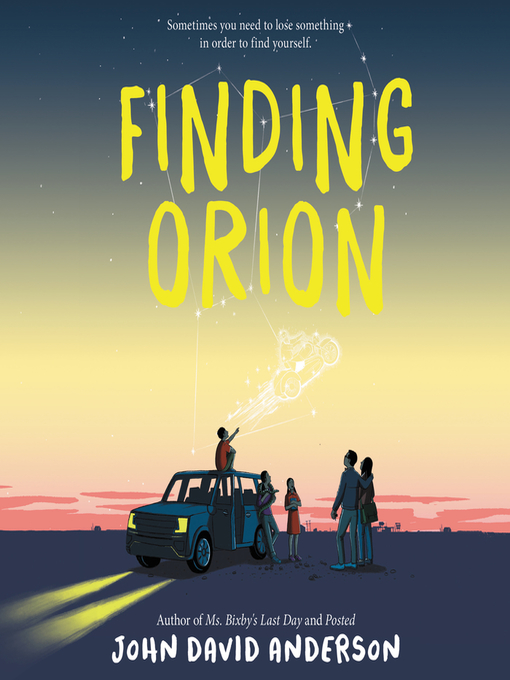
Finding Orion is an extremely well-written book with a lot to offer. The book is told from the perspective of a twelve year old boy named after the constellation Orion who feels out of place in the Kwirk family. His dad works in a Jellybean factory, his mother is allergic to almost everything and feels the need to clean tirelessly, his sister is obsessed with fencing, acting, and owns a pet snake, while his youngest sister is a walking dictionary. Because of this Rion feels his family is very different from himself and other "normal" families. Although Rion has always tried to live his own life and be normal, when a clown shows up at his doorstep to deliver the news of his grandfather's death, it ends up uncovering a deep conflict between his father and his grandfather and he discovers a lot more about his family.

One of the most prominent themes talked about and represented in the novel is bizarreness. Bizarreness is shown in many ways throughout the story by the Kwirk family with his family being much different from his friends' families. But perhaps the most bizarre of them all is Papa Kwirk, who only shows up on Christmas every year to bring odd gifts and tell exciting stories. Although the bizarreness is shown by both Rion's grandfather and his family, Rion comes to look up to Papa Kwirk's mysterious and wild lifestyle. While he often feels ashamed of his family who has a more toned-down bizarreness, which is brought on by his need to fit in at his middle school. All in all, the bizarreness of the Kwirks leads them on an adventure that helps Rion learn to appreciate his family for what they are.

The novel's main character, Rion, is a very unique and complex character for many reasons. One being that because he feels he doesn't belong in his family, he ends up talking less than everyone else, which makes him very observant. His ability to read a situation and his frequent intuitive and clever remarks that he mostly keeps to himself explain why he was chosen as the narrator of the story, and show the reader that he is a lot more like his family than he admits. Going onwards, his observant attitude proves to be very a informative and entertaining perspective, as he, more than his mother and siblings, has an interest in the odd life that Papa Kwirk lived as well as the origin of the conflict between his dad and Papa Kwirk. This interest causes him to play a key role in uncovering the mystery of his grandfather and makes him an interesting character to follow.

Although the novel is told from Rion's perspective, I think that the variety of unique attributes in the different characters makes this a story that everyone can relate to some way. Overall, this book is a funny yet moving and heartfelt novel that I would highly recommend, with characters and conflicts that I often found myself relating to.


Finding Orion: Anderson, John David: 9780062643896: Amazon.com: Books

- Kelby Svendsen

Tuesday, March 2, 2021

Looking for an Enemies to Lovers Story? - The Hating Game by Sally Thorne


The Hating Game


When I started reading The Hating Game, I was immediately drawn in. The contemporary romance novel by Sally Thorne is about executive assistants to the co-CEOs of a publishing company. Lucy and Joshua are two opposites who deeply hate each other. They spend their days sitting across one another, displaying their feelings through passive aggressive maneuvers. When they are pitted against each other for a promotion, themes of rivalry and romance arise. 

While each character has rather interesting qualities, my favorite is the narrator Lucy. She is witty, bright, and energetic with a colorful personality. Her persona strongly contrasts Joshua’s. Lucy craves adventure and is free-spirited. Her coworkers view her as organized and intelligent. However, readers realize not far into the story that Lucy is rather lonely. Her parents own a strawberry farm in a different state and she got into a disagreement with her only close friend. This character is complex because she gives off a lively persona but on the inside feels alone. 

Lucy is not the only lonely character in The Hating Game. Joshua, although afraid to admit it, feels like he does not live up to his family’s expectations. To others, he seems emotionless and cold. Since they work right across from each other, Lucy notices that he is not as tough as he appears to be. I think their dynamic once realizing their similarities makes the story much more interesting. It gives them a stronger connection besides working together. Once they are aware of their shared experiences, they stop hating each other so much. 

I have not finished the novel yet but am excited to see where the story takes Lucy and Joshua. The plot seems predictable but there are twists and turns every chapter. It gets exciting to see how Lucy and Joshua interact when they cover up their feelings for each other with hate. At the start, I did not have much empathy for them. However, I connected to them after reading about their habits and longings. Based on what I’ve read so far, I recommend The Hating Game to anyone who wants a gripping story full of laughter, love, and well, a bit of hate.

-Noreen


Saturday, February 6, 2021

A Book on How People Gain and Keep Power


        Are you an ambitious ruler willing to make your nation a better place? Are you frustrated at the seeming ineptitude of your leaders, ignoring the good of the people to serve their own cronies and supporters? Perhaps you think that if you were in charge, you would work for the people, and watch your nation with pride as it prospers with you at the head. Or you may have more sinister ideas for your power, such as enriching yourself, your friends, and your family, without a care for the ordinary people suffering outside the door. Before you act on your ambitions however, it is important that you understand the position of leadership you're striving for, and what it requires. And The Dictator's Handbook is just the right book to learn about how to secure and use your power. 
        Written by two political scientists named Bruce Bueno de Mesquita and Alastair Smith, The Dictator's Handbook outlines the basic concepts which guide any successful leader's decisions. It explains a large majority of the political world with the power of a simple statement: the first goal of a leader is to survive in power, while all other ambitions are secondary. If you are someone curious about political maneuvering, or even want to become involved in the world of politics, this will be an intriguing and engaging educational book for you to read. 

        One of the great parts of the book is the fact that almost all of its content focuses on a basic concept: the need for a leader to stay in power. After all, the leadership role comes with a lot of power, and losing that position would be an extreme setback to your ambitions. The only way to secure power is to have people who are content in keeping you at the helm, and have the power to do so. The book dubs these people as "essential supporters" who are part of the leaders "winning coalition." Depending on the system of governance, these people may be different. For example, in an ideal democracy, this "winning coalition" is 50% of the voting population, while in a dictatorship, it would be a handful of powerful individuals, usually coming down to security forces and important ministers. Leaders have to satiate their needs and interests, lest they revolt and get in the way of your own ambitions. This book hones in on this concept again and again, using these basic concepts to explain tendencies of leaders, and contrasting autocratic and democratic societies with these explanations. 
        The number of questions answered with these basic concepts is astounding. The ideas presented include why some leaders create and extensive and efficient welfare system while others do not, why some tax heavily and others do not, and why some leaders turn a blind eye to corruption while others do not. The rules of politics aren't limited to domestic policy either. The book also highlights several ways in which international relations, such as aid, alliances, and war are influenced by the need for a leader to survive in office. 
        The Dictator's Handbook also does not hesitate to bring examples of these concepts up, by highlighting specific instances in which a behavior is present in leaders, and comparing countries with different political systems and analyzing how these systems affected their development. Of course, this all is done through the lens of a leader focused on political survival. 

        This book is one of the most interesting nonfiction reads that you will ever encounter. The amount of information, anecdotes, and concepts introduced is quite large, making their arguments more intriguing and convincing. If you have any interest in politics and history, or are just generally interested in new ideas and concepts, I definitely recommend you read this book. It's generally a great read, and perhaps one day, you will have a nation in your grasp, and you will turn to these author's writings as your very own dictator's handbook.         

Monday, February 1, 2021

What Does Death Have to Say?


        Inhuman, cold-hearted, and sinister are words that come to mind when I think of death. Perhaps because our representation of death, the Grim Reaper, wears a dark cloak and carries a scythe not intended for cutting wheat. Not only does his scythe remind you to keep your distance, but his hooded robe also adds an air of mystery because it is quite difficult to tell what he is thinking. Well, that is, until you read The Book Thief. The complex story, written by Markus Zusack, is narrated by none other than Death himself. Through his eyes, we see the main character Liesel adjusting to a new life with her foster family during WWII in Nazi Germany. At 10 years old, she cannot read but desperately wants to, so she works hard with her foster father to learn how. Her hunger for reading draws her to seek out any book she can find, even if it means stealing. Thus the name The Book Thief is given to her by her friend Rudy Steiner, a neighborhood boy her age. Liesel’s foster family is soon faced with a life-threatening situation when they take in a Jewish man, Max, in need of refuge. 

 Death is often portrayed as vengeful, but Zusack gives Death a sense of humor, compassion, and other humanlike characteristics. For example, Max suddenly becomes quite ill, yet Death wasn’t excited to take his soul or was hopeful that he would join him. Written as a “Late Night Excerpt,” Death recalls, “It must have been one of the few moments when the girl was not there with him, for all I saw was a man in bed. I knelt. I readied myself to insert my hands through the blankets. Then there was a resurgence--an immense struggle against my weight. I withdrew, and with so much work ahead of me, it was nice to be fought off in that dark little room. I even managed a short, closed-eyed pause of serenity before I made my way out” (Zusack 317-318). Although many times death is something that people fear, I never thought of Death also being reluctant towards our demise, but that’s what makes him seem more human. His hesitance is almost more comforting because it’s no longer like he is waiting for us. Being in the hands of someone who is more like us lets the possibility of dying become less intimidating.


Death’s descriptions of what it’s like to pick up the fallen souls is both beautiful and filled with sorrow. As he tells of the time he was in a German prison where a group of French Jews were being held, he says, “Please believe me when I tell you that I picked up each soul that day as if it were newly born. I even kissed a few weary, poisoned cheeks. I listened to their last, gasping cries. Their vanishing words. I watched their love visions and freed them from their fear...They were French, they were Jews, and they were you” (350). Not only are these prisoners Jewish, but they are French, they are men and women: they are people. We continue to create divisions and differences amongst ourselves even though we will all meet the same fate, and yet we let those separations cause our own peril. However, while it is us who creates those differences, it is also up to how we interpret them. Liesel, who has recurring nightmares of the death of her younger brother, learns that Max also has traumatizing nightmares. One night, when she hears that Max is especially restless, she asks him what he dreams about, leading to the “swapping of nightmares” (220). Although they are girl and man, young and old, German and Jewish, they’re comforted to learn they are not alone, and a wonderful friendship grows. If everyone’s ultimate destination is death, then our differences shouldn’t have to set us apart.


Not only is death a part of us, but we also have a part in death. We are offered a description of Death’s appearance: “I do not carry a sickle or scythe. I only wear a hooded black robe when it’s cold. And I don’t have those skull-like facial features you seem to enjoy pinning on me from a distance. You want to know what I truly look like? I’ll help you out. Find yourself a mirror while I continue” (307). It’s not about who cleans up the mess, but who causes it, and the answer is us. While black robes and scythes are out of style, our actions make up for it. Death is not hunting for people to take with him. Instead, we are creating more reasons for us to join him. When speaking of the war taking place in the novel, Death says that he rejects the saying, “war is death’s best friend.” He says that war is like a controlling leader who calls on him like a servant, with impossible standards and no thank-you’s in return (309). I agree with him because it doesn’t seem that death and war work together, rather, death happens to be the result of the wars invoked by us. 


There is much more to unpack in this novel: Liesel’s journey as a reader, her friendship with Max, and more, but unfortunately there is no time. I haven’t finished all of it yet, but I’m excited to see what’s next, and I hope you give it a try.


--Grace


My Blog Post Has Transformed into a Listicle

     Sophie’s World, by Jostein Gaarder, is definitely a gear-turner. Set in a Norwegian village, a 14-year old girl named Sophie receives ...