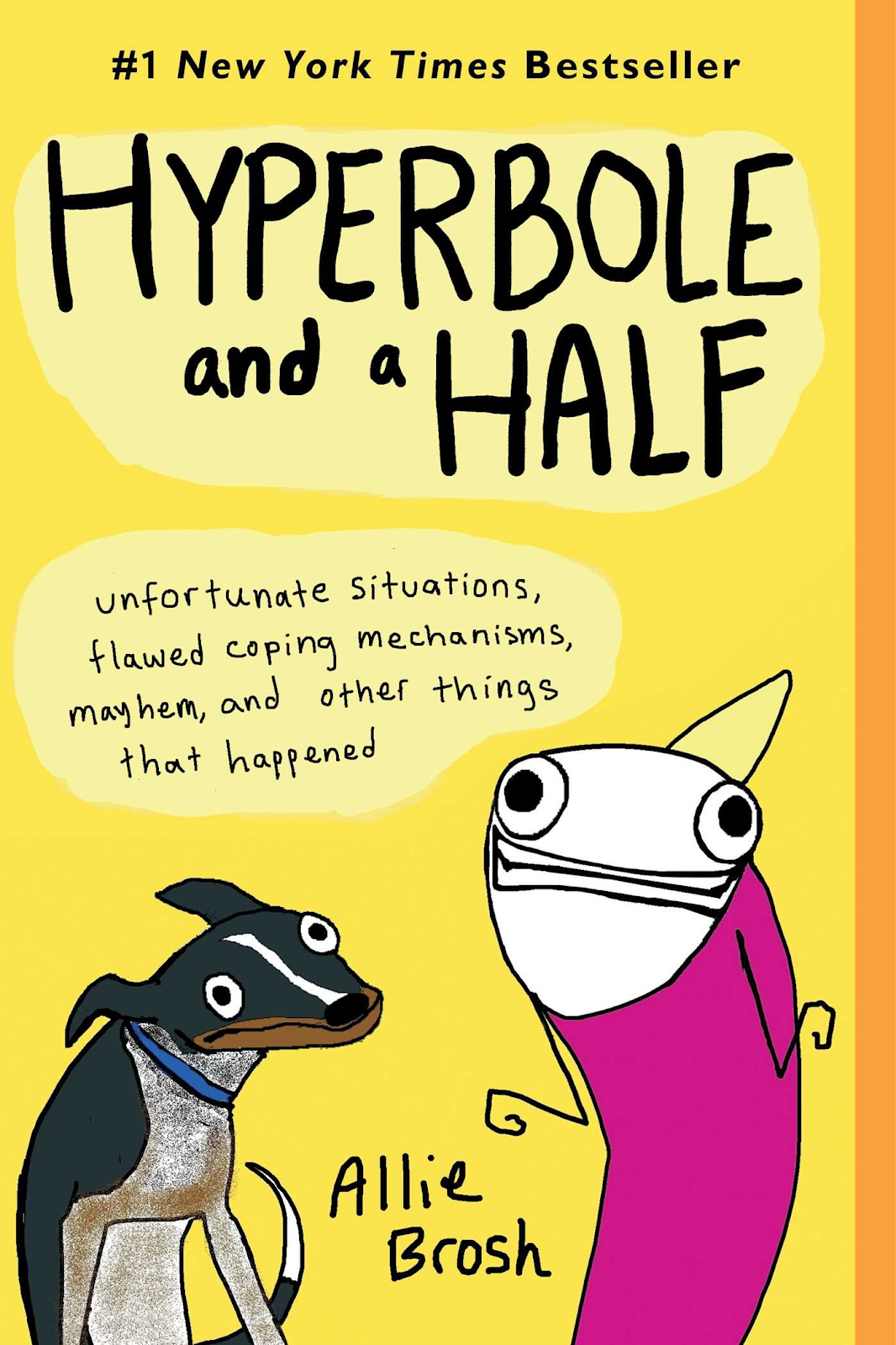

The hard-to-believe but true stories of Allie Brosh create the humorous and slightly concerning autobiographical graphic novel Hyperbole and a Half. She invites us into the mind of her dog-obsessed childhood self, tells of her “simple-dog” and “helper dog,” and also shares a candid insight into her struggles with depression.
Her childhood stories are the parts that made me laugh out loud the most because while she was already a quirky child, the humor that she uses to express those peculiarities makes them even funnier. Normally, adults don’t always remember what they were thinking when they were younger, but it seems that Brosh still has quite a healthy relationship with her child-self. In one of the first stories in the graphic novel, she tells about the time when she found a letter to her future 25-year-old self written by her ten-year-old self. The letter asks multiple questions on the topics of dogs: “Do you still like dogs? What is your favorite dog? Do you have a job training dogs? Is Murphy [her current dog] still alive?"(Brosh 5) It also had an “About me” section where she made sure to state her favorite dog breeds. And at the end, it had the sentence that Brosh describes as “the three most disturbing words in the entire letter: Please write back.” She says, “judging by the thick, purposeful lines in each letter...the sincerity of the request is unmistakable” (6). There are more times like these where Brosh reminisces about her past actions or events with semi-sarcastic yet reflective commentary. But her written memories express the honest thoughts of when you’re a kid and your actions seem perfectly reasonable, which made for a nostalgic read….even though I realize I’m only fifteen.

She also shares the times when she had depression as an adult. Even though depression is a serious and sensitive topic, she is able to bring sardonic humor to the bitter moments. She allows us, the readers, to still maintain a connection with her, even during the more uncomfortable and difficult times of her life. She has two sections in her book labeled “Depression Part One” and “Depression Part 2.” She starts off “Depression Part One” by saying, “Some people have a legitimate reason to feel depressed, but not me. I just woke up one day feeling arbitrarily sad and helpless” (99). The way she explains her experience with depression makes it easy for readers to empathize with her and understand exactly what she means. She also gives examples that show what she was like during this period. Like the time she felt invincible at the video store because she “didn’t have any feelings left” and rented six horror movies, bought all of the skittles, and then “swooped out of there like the Batman and biked home in a blaze of defiant glory” (115-119). I think writing about those candid moments is also helpful for a lot of readers experiencing the same thing. I appreciate how she incorporated humor into both her writing and drawings, punctuating her present thoughts and emotions. For me, that’s what I can connect with the most (humor), so it was quite effective.

I feel like since dogs were an important part of Brosh’s life, I should probably mention them. As an adult, she has two dogs: The “simple dog” who is, well, a bit simple but tries her best, and then there is the “helper dog,” who tries to teach the simple-dog how to be bad. She devotes a section to each one. The first one is about how she runs a series of tests on her simple dog until finally accepting that her dog is just simple, and the second one is about getting the helper dog and learning about all of the not-so-fun qualities that she has. However, she loves them both very much. The facial expressions that she gives each dog are funny, and the thought bubbles are great additions too.

The Simple Dog (left) & Helper Dog (right)
Reading Hyperbole and a Half is like drinking a refreshing glass of seltzer water: It’s addictive, fun, and when you choke on the bubbles, that’s just because you're laughing so hard. I hope you try it.
--Grace